AstraZenecaPart 2 of 5
Record the decision. Don't make it.
About 1,600 people could request a policy exception. About a dozen could see the risk register. I specified how requests get in without exposing risk data, how a committee's decision gets recorded when there's no voting rule, and how to keep an unapproved workflow from delaying approved work. Compliance hadn't approved the workflow by my last spec. For two research-review committees, I mapped the work before designing an assistant, and found one coordinator doing nearly all of it.
- Role
- My contract title was Senior UI/UX Business Analyst; I also worked as a UX designer and AI engineer. I designed and built across compliance, internal products, forecasting and medical AI, with business owners and engineering teams.
Facts
- Engagement
- August 2025 to August 2026
- Contract title
- Senior UI/UX Business Analyst
- Business units
- US Oncology, then Global Medical Affairs from May 2026
- Released
- Risk register, March 2026. Spec by me, built by ECS.
- PinkPulse
- Working resource hub for the breast franchise; I designed its discovery and interface directions.
- AI Workbench
- Working Global Medical Affairs product; my interface and workflow prototypes shaped the shared experience.
- Worked with
- A Compliance business owner and reviewers, AstraZeneca's delivery team ECS in India, medical specialists, engineers and a leadership sponsor
Policy exceptions
The request, and three facts that shaped it
A policy exception is a request to do something outside an existing Compliance policy. The right leaders read it and decide before anything goes ahead, and the decision has to leave a record that holds up later.
In April 2026 the Compliance business owner asked for policy exceptions to live inside the risk register we had launched in March. ECS, AstraZeneca's delivery team in India, which built the app in Power Apps, would build this part too. Three facts shaped the requirements.
First, about 1,600 people in the US business unit could ask for an exception, and about a dozen could see the risk register. Those are the business owner's figures, rounded.
Second, a committee of about ten people decided, and who signed off changed with the exception. Compliance had no rule for how many of them had to agree.
Third, Compliance hadn't approved the workflow itself. The two registers it would sit beside were approved on 16 April.
I wrote the requirements, kept the list of open decisions, and built prototypes so people could react to screens instead of paragraphs.
Let anyone ask without showing them the register
Two ways to take requests were on the table: Microsoft Forms, then a separate app ECS proposed. The business owner turned both down. The people asking for exceptions were senior, and a separate link was one more thing for them to keep track of.
So the design became one app with a Policy Exception tab. Someone who isn't a register member sees that tab and nothing else. I wrote it into the spec: intake inside the app, no external form, no public access, and exception records in their own list, apart from risks and mitigations. Every request still passes single sign-on and a role check.
For a requester, the exception tab had to be easy to find. For a register owner, the risk records had to stay out of that requester's reach. The same sign-on could serve both without making their permissions the same.
Who sees what

Record the decision. Don't make it.
Nobody had written a quorum rule. Not 60 percent, not seven of ten. A system can't enforce a rule the business hasn't made, and it shouldn't guess one.
The business owner proposed that an administrator mark the outcome by hand once the committee had responded. I specified the limits of that role.
Records, not an approver
The administrator records the committee's decision and is not an approver. The system never approves anything on a vote count. There's no quorum or majority logic anywhere in it.
Each reviewer's decision stays in the version history with their name, role, time and reason. Declining needs a reason, and asking for more information needs a question. The recorded status is one of three: Approved, Declined, or Under Review when the committee needs more time.
A working session on 29 April confirmed the recording role, the three statuses and four reviewing committees. Four questions stayed open, and the spec says so: how many reviewers each committee needs, whether they review in order or in parallel, how long they have to respond, and what happens when a request sits too long.
Request, review, decision

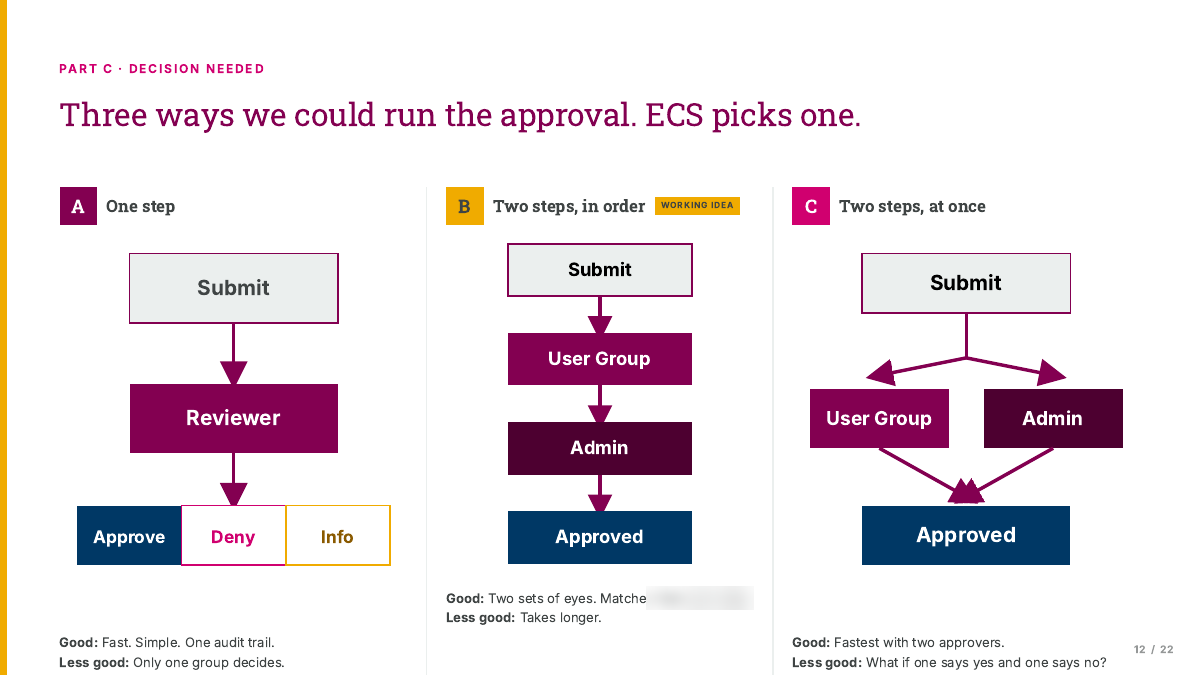
Three ways to run the approval
Before the committee structure was settled, I put three options on one slide for ECS and the business owner. One reviewer was simple, but one group decided alone. Two stages in order gave a second check and took longer. Two stages at once was fastest, but it left a question nobody had answered. What if one says yes and the other says no?
Two stages in order was the working idea on 21 April. The structure confirmed on 29 April looks like that option with one change that mattered. The second step records the committee's decision instead of adding a second approval.
The approval options
Keep the unapproved work off the critical path
Phase 2 held two approved registers, US and Global, and one workflow nobody had approved. ECS's build order put policy exceptions second. The business owner didn't want it holding anything up and wanted it clearly separate from the register.
So I moved the whole workflow out of the Phase 2 requirements table into its own section of the spec, headed "pending Compliance approval". That section says it doesn't block either register. ECS could build what Compliance had approved while Compliance decided on the rest.
Shared where it's safe, separate where it matters
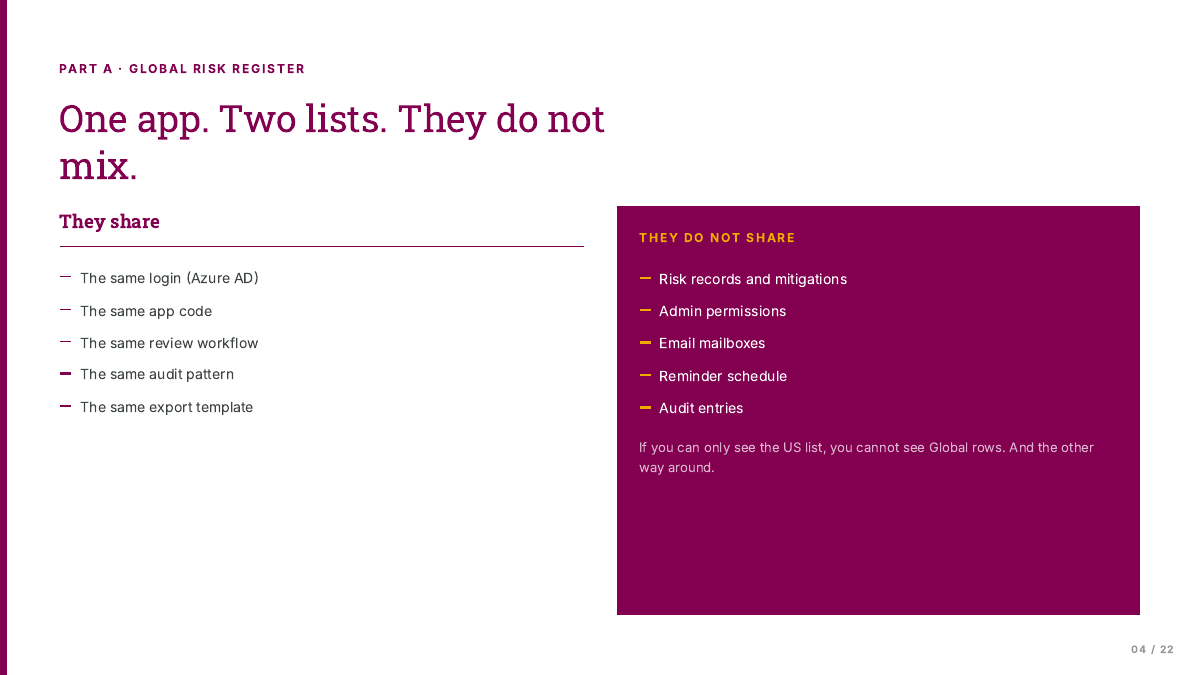
The Global team wanted the same register. By late April the business owner put it at about 95 percent the same, with its own admins, its own leaders and six risk areas instead of three. My April deck proposed one app with two lists that don't mix. The login, app code, review workflow, audit pattern and export template were shared. Records, admin rights, mailboxes, reminder schedules and audit entries stayed separate. Someone who could see the US list couldn't see Global rows, and the reverse.
Policy exceptions were US only, and they got the same treatment, with their own list and their own mailbox.
One app, two lists
What the prototypes were for
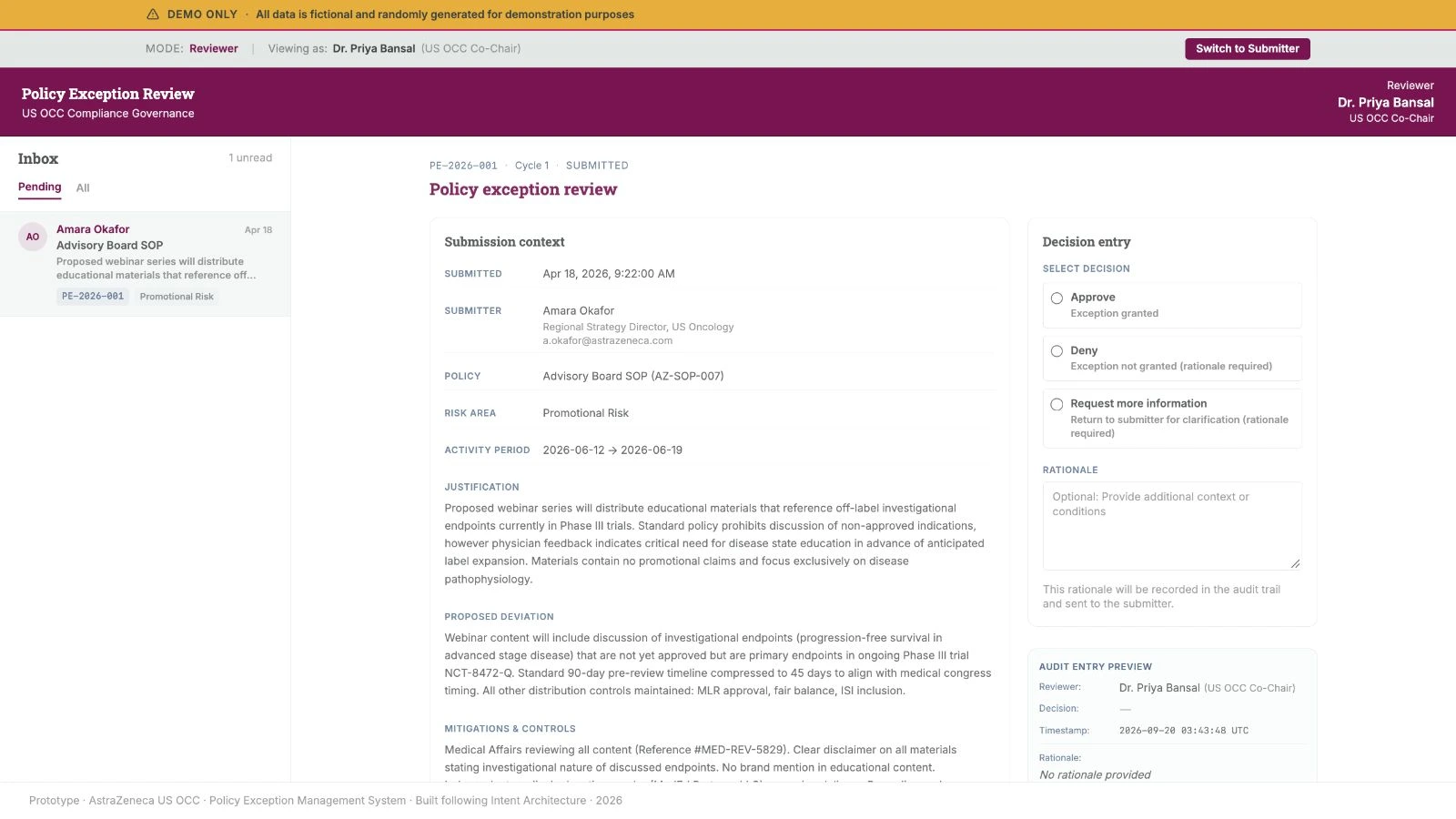
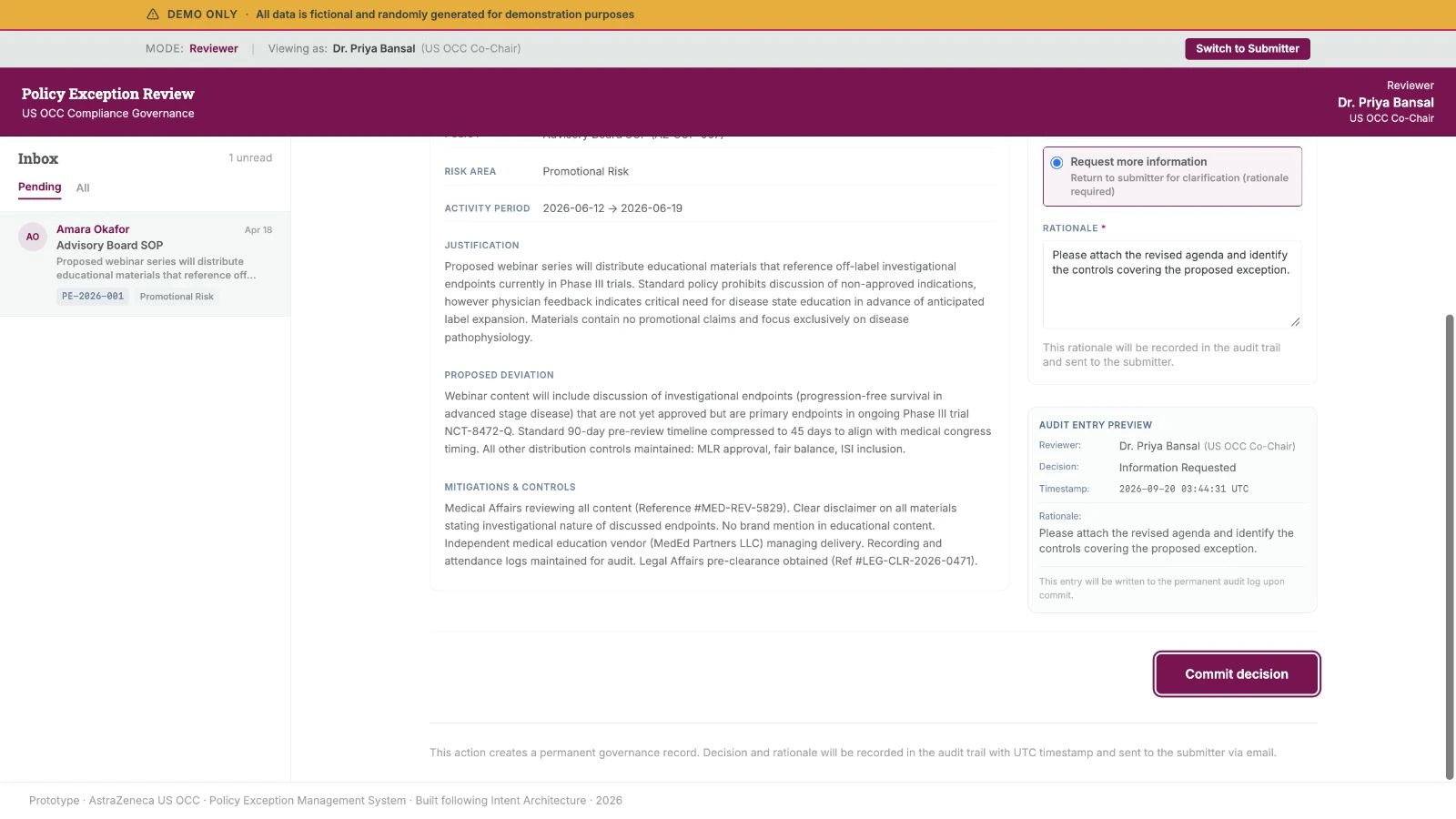
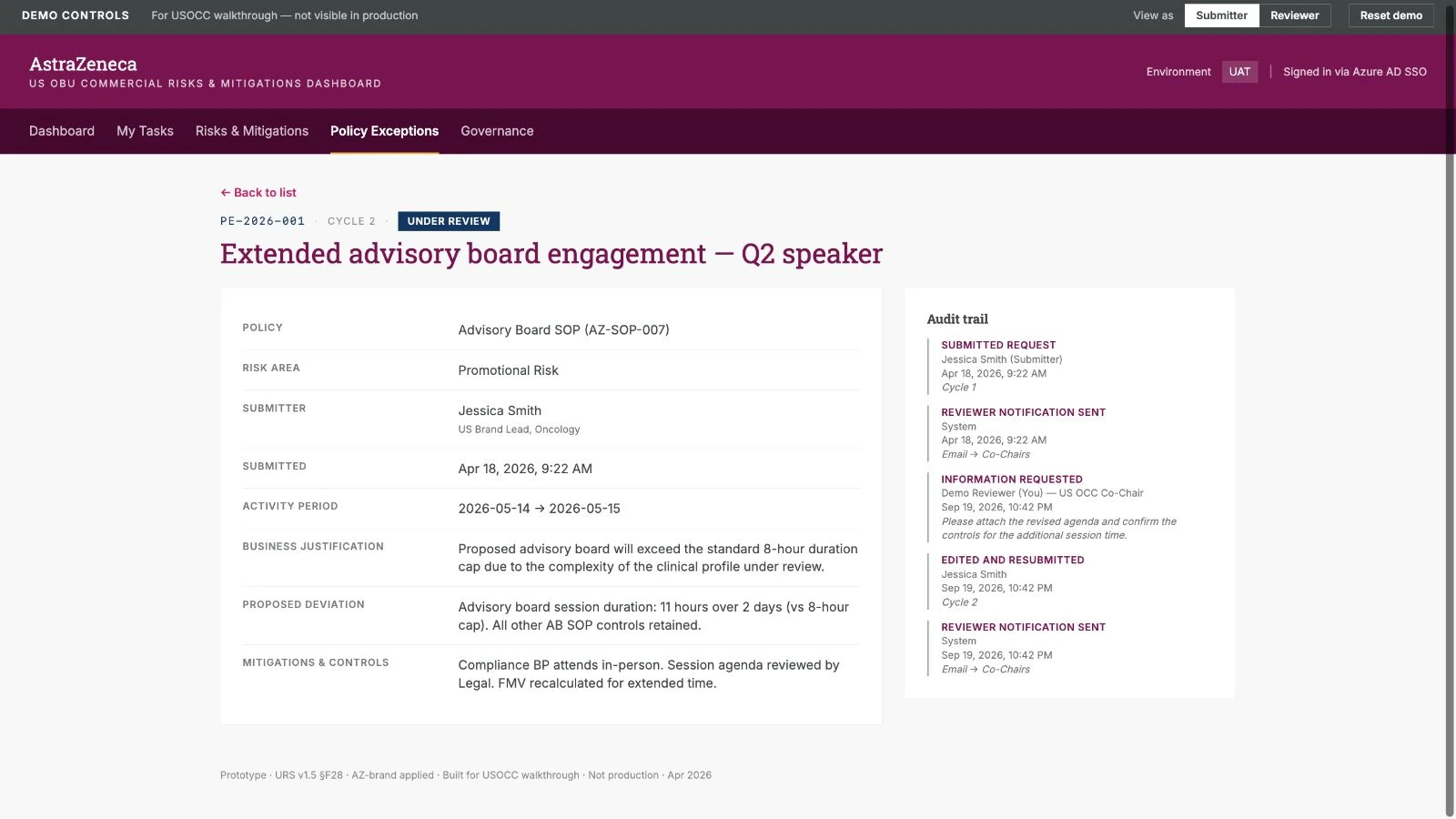
I built two prototypes before the rules were final. The Figma one gave the request two-thirds of the screen and the decision one-third. It wouldn't let a reviewer decline or ask for more information without writing a reason, and it showed that reason in the audit entry before the reviewer committed. The HTML one showed a request going back to the requester and returning as a second review cycle on the same record, with the earlier events kept.
In the walkthrough, the business owner pointed out that someone seeing it for the first time could mistake the sample requests for real ones. The spec then required test copies to be clearly marked as sample data. After the walkthrough, the business owner asked for the link to share with the team.
Scope
Both prototypes predate the final rules. They say Deny instead of Decline, and they don't have the recording step.
The prototypes
Where it ended
Compliance hadn't approved the policy-exception workflow by the last version of the spec I wrote, dated 29 April 2026. That version still marks it "pending Compliance approval". In May 2026 my work moved to the AI Workbench and I handed the requirements over. I don't know whether the workflow was built.
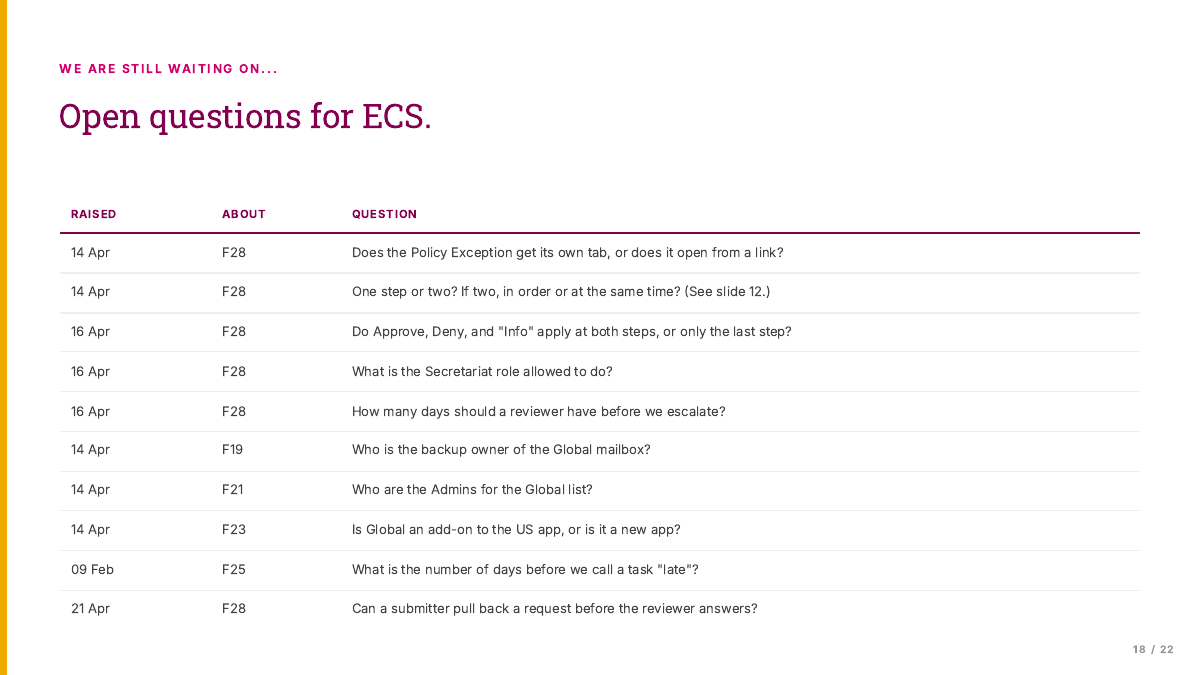
What I can point to is the record. Each version of the spec recorded what changed and whose review drove it. The open questions sat in one list with the date each was raised, ten of them going into the April review. Confirmed decisions and open ones are marked differently in the text, so nobody had to guess which was which.
The open questions in April
Research reviews
Map the work before redrawing the screen
In March 2026 the lead for two research-review processes asked me for a prototype. One process handles proposals from outside researchers who want AstraZeneca to support their study. The other runs internal study documents past a panel of specialists. A vendor had already built a Power Apps version that read the PDFs and filled in some fields. Leadership looked at it and said it wasn't agentic at all.
The easy move was to reskin the vendor's form as a chat window. Instead, the same day as the first call, I turned the requirements document and the walkthrough into nineteen FigJam maps: who does what, each process as it ran, swimlanes by role, data flows, decision rules, the system architecture and the pain points at every stage. Then a future-state version of each.
Where the manual work sat

Design for the coordinator, not the committee
The maps turned up the finding that shaped everything after. Committee members read, commented and decided. One coordinator role sat in the middle of both processes, writing every triage email, chasing every late reviewer, building every folder and typing every status update. So I designed the assistant around that person's queue. The agent drafts and tracks. The coordinator reviews and sends. Medical leads and the committee keep every decision.
What moves, and what stays

Where it went
The prototype became the research governance assistants, one for each process in a single portal. Each opens on what's overdue, and every answer comes with its next action attached. The AI prototypes part shows the screens. On 1 April they were paused, because nobody had approved a budget for the next phase. Nothing was built.
Scope
The maps came from the requirements document and the process lead's walkthrough, not from watching the coordinators at work.
Business-rule changes
A second review flow: business-rule changes
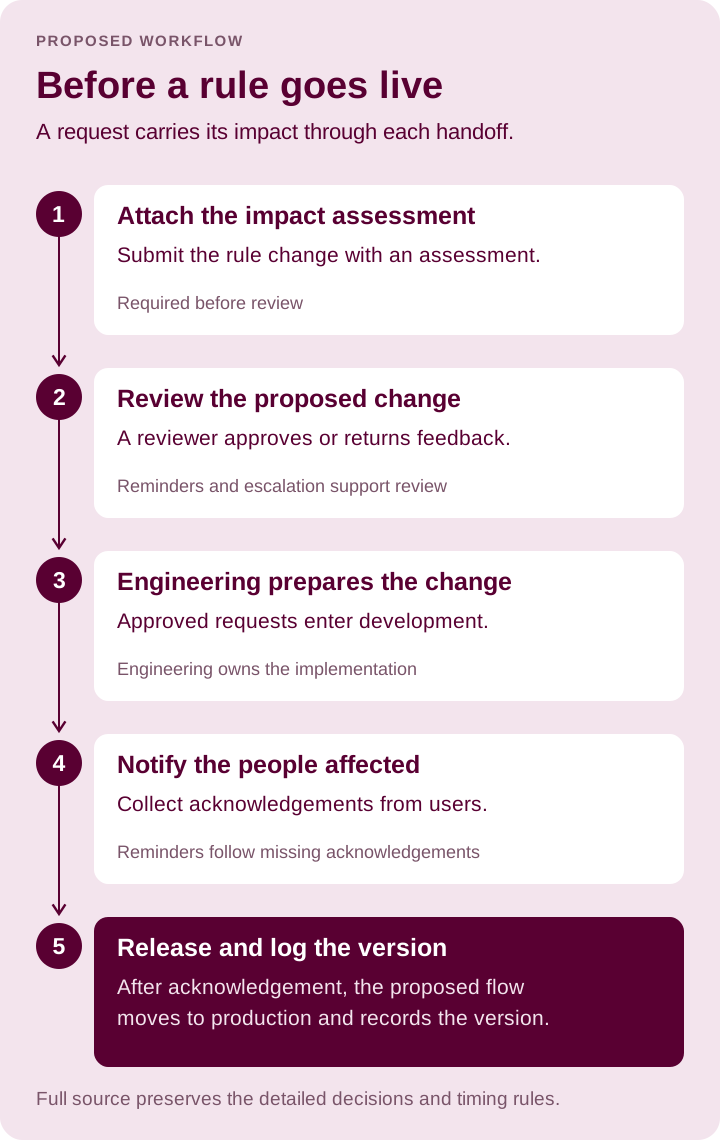
In a separate assignment I mapped a portal for proposing changes to business rules. The requester tests the change and attaches an impact assessment before review can start. Rejected requests go back with feedback, silent reviewers get reminders, and engineers keep control of applying approved changes. It stayed a proposal.
The proposal, read as five steps
Results
- Stated by the business owner: about 1,600 possible requesters and about a dozen register viewers. I specified in-app intake so requesters could submit without seeing any risk data.
- I specified that the system records the committee's decision and never approves on a vote count. A working session on 29 April confirmed the recording role, three statuses and four committees.
- I kept the unapproved workflow in its own section of the spec so it couldn't hold up the two approved registers.
- For two research-review committees, I mapped both processes before designing anything. The maps showed one coordinator doing nearly all the manual work, so the assistant I proposed drafted and tracked for that person and left every decision with people.
Evidence limit
Compliance hadn't approved the policy-exception workflow by my last spec on 29 April 2026, and I don't know whether it was built. The prototypes predate the final rules. The research-review assistants and the business-rule portal stayed proposals.